
A painter of great lyricism and sensitivity, Stopforth captures the majesty and drama of the British landscape at its wildest, while expressing a profound reverence for the sublime tradition.
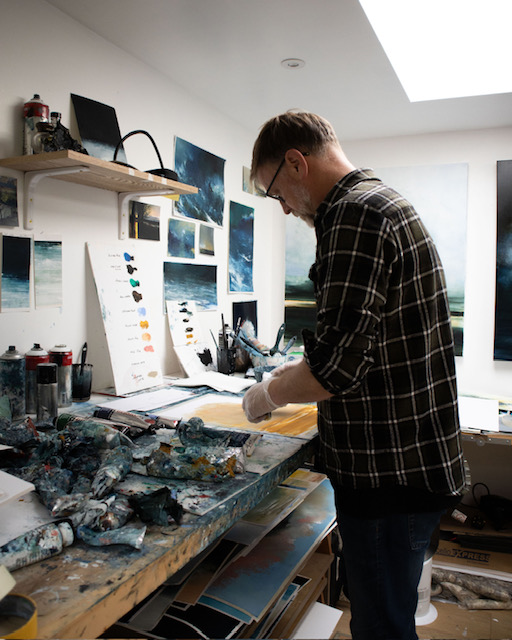
His work over the past twenty years has been devoted to those vistas that are associated with the untamed and wild atmosphere that can be found in the moors, fens, fells and estuaries of Britain. He has carried those impressions of the sublime in the landscape that were left on him as a child growing up in the Fens of East Anglia, impressions that are still relevant to his work today. Recently it has been the vast immersive spaces of moorland and river estuary that have consumed Mark’s imagination and which he strives to evoke through charcoal, pencil and oil.
His influences are many and varied, and include the calligraphic paintings of Cy Twombly, the tonal ink paintings of Hasegawa Tohaku and the landscapes of Constable, Claude, Cotman and Turner.
Mark has exhibited work around the country, most notably on a number of occasions at the RWA in Bristol. He has also been successful as a published poet, being shortlisted for the Brit Writers’ Award in 2012 and winning Fleeting Magazine’s International Best Short Writing prize in 2010. Writing has been put on the shelf for the time being as Mark wishes to devote himself full-time to landscape painting.
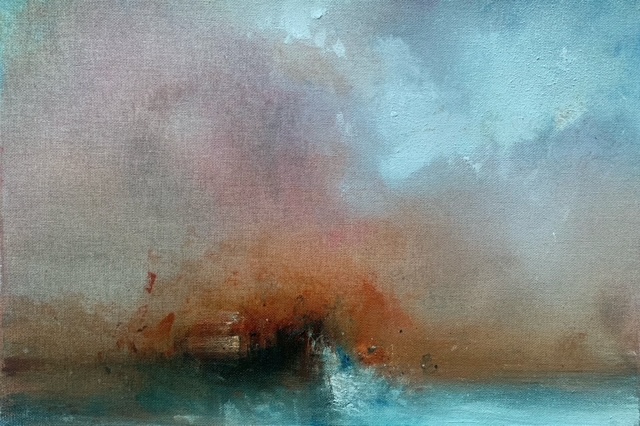
In what ways does memory —personal, collective, or even linked to your earliest landscapes— influence the way you construct those spaces that sometimes feel remembered rather than simply observed?
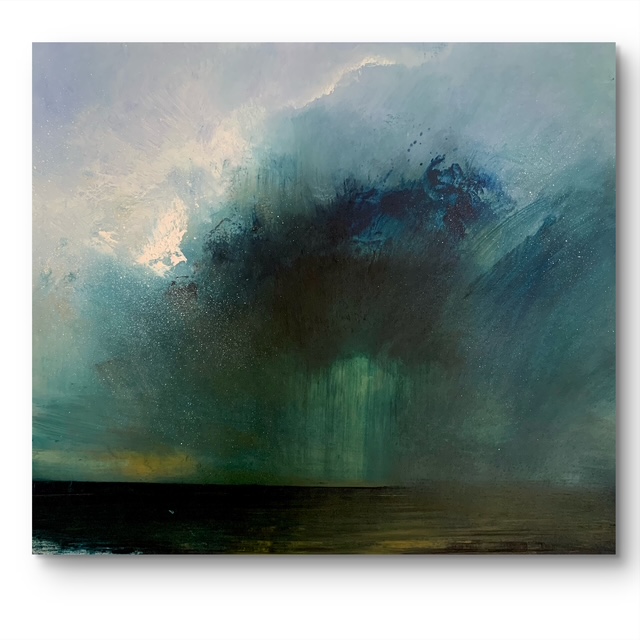
These are indeed landscapes that are remembered rather than being rendered directly from working outside. I’m constantly looking for an emotional connection with the paint and the atmosphere or mood created. The work is created quickly and intuitively which can prove to be energy sapping but it’s always worth it for that one moment where it all comes together. Where the landscape being painted consumes me.
Your works seem to exist in a point of transition, between appearance and disappearance. What happens for you in that threshold where light is not yet light and form is only beginning to emerge?
I lose myself. I’m given over to the process. It is, on an experiential basis clearly very personal but I’d like to think that comes across, that anyone caught by the painting can lose themselves as well. It’s that shredding away of ego and stepping outside of oneself which makes Art, for me, both captivating and exhilarating.
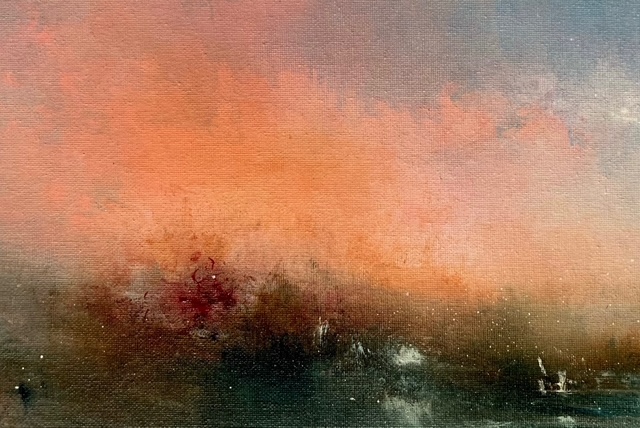
There is a very precise balance between gesture and silence in your pieces. How do you decide when a work has reached its exact point, and when one more mark would break the atmosphere you are seeking?
That’s possibly the moment where Art, in its loosest definition, occurs. I think there are degrees of completeness without having a clearly defined image to work towards leaving that moment open ended. The paintings will always contain a moment of rightness which is what I’m clearly working towards. There are degrees of separation around that. The better paintings are closest to where that moment of wholeness, of rightness resides.
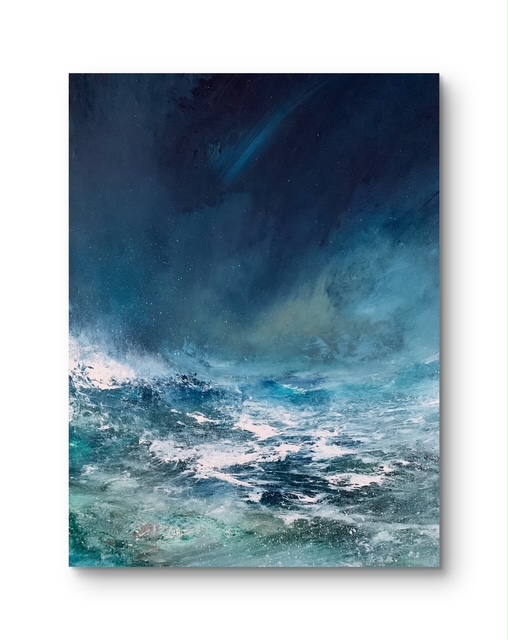
Weather —fog, wind, humidity, storm— feels like another character in your work. What role does meteorology play in your creative process, and how does it influence the emotional tone of each piece?
I’m constantly looking towards the sky, there is no such thing as boring weather to my mind and we, the British, love to talk about the weather. As for emotional tones, even with the darkest of storms I like to offer a sense of light within the storm itself, which then provides a narrative of hope if you will. My inspiration comes from art, literature and music which is Romantic by nature yet touches upon that notion of the sublime, where something is bigger than you, the ego again lost to nature.
Your works often inhabit a space of transition. Which creative horizons do you feel yourself moving toward now, and what new atmospheres would you like to explore in the future?
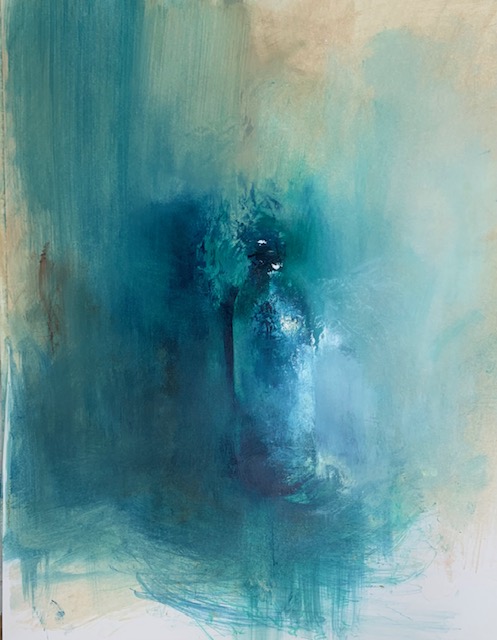
I have recently been working on a series of paintings that deal with landscapes that inhabit that space between land, estuary and sea. Again, based upon childhood memories growing up in the Fenlands of Norfolk. A landscape reclaimed from the sea that echoes with the songs of curlews and lapwings. It’s a landscape that haunts me still. I’m also directing more of my energies towards minimalist still lifes, which are as close to portraiture as I’ll ever get.
Story/dream
Travelling back from London across the Fens in the family car, which was a regular journey. I would often insist on stopping and watching the sun set across the low flat horizons of the peat fields that would stretch out forever under eternal skies. I would have been a toddler at the time. My parents, to their credit, never refused me.
My other anecdote is of a dream where I was on a dark, storm swept moor being chased by a ball of light. No matter where I ran or hid it would find me. In the end I gave up and approached this ball of electric white light which was fizzing and spitting with energy. I first put my hands in then my arms and then stepped in to be consumed by this white electric light that then filled my head. It was very vivid and rather wonderful.

Take a moment to discover his work — it moved me deeply, and I hope it moves you too.